
Beneath the Surface: an exhibition celebrating 300 issues of Descent Magazine
The world beneath the surface is one of great variety, home to stunning formations, unique wildlife, meandering passages and vast chambers.
Since its launch in January 1969, Descent: the magazine of underground exploration has become the go-to periodical for cavers and mine explorers not only in the UK but around the world. We have recently published our 300th issue and, as part of the celebrations for this milestone, we want to showcase the work of some of the best underground photographers.
This itinerant exhibition began on 4 December 2024 at No-Hands Rest Coffeehouse in Kendal and can currently be seen at Fell Bar.
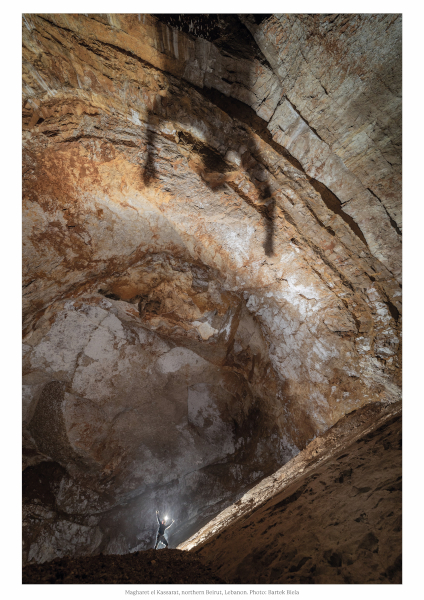
Magharet el Kassarat, East of Beirut, Lebanon. Photo: Bartek Biela
This cave system, located 15km East from Beirut, provides a water source for the city and has been damaged by heavy quarrying in the area. Despite this, the system has some of the most beautiful formations in the country. These must be protected and preserved for future generations.
Bartek is a UK-based caver with a passion for exploring the hidden wonders of the underground world and capturing their beauty through photography. Over the years, his passion earned him recognition at events such as the Hidden Earth conferences, the NSS convention, and various European competitions.
To see more of Bartek’s photos:
https://www.flickr.com/photos/91392939@N07/
https://www.instagram.com/bartek_biela
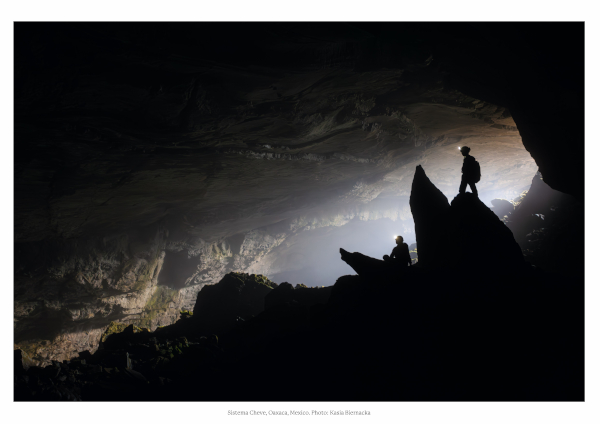
Sistema Cheve, Oaxaca, Mexico. Photo: Kasia Biernacka
Descending to -1,529m, Cheve is currently the second deepest known cave in the Americas and 11th deepest in the world, with a total length of approximately 90km. The exploration of this difficult and complex cave is an ongoing project. There is often mist inside the enormous entrance, especially in the morning, which adds to the mystical feeling of the place.
Kasia Biernacka is an expedition caver and outdoor photographer based in Poland. When not underground or in the woods, Kasia works as Film Program Director for the Ladek Mountain Festival, translates outdoor films into Polish and runs the Ladek Film Tour. She has worked as a camera person in two film productions about cave exploration, gives talks about her expeditions and runs cave photography workshops.
To see more of Kasia’s photos:
www.kasiabiernacka.com
https://www.instagram.com/kasiabiernacka_photography/
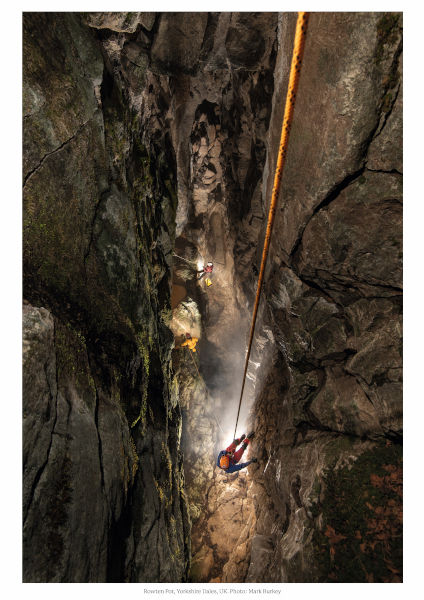
Rowten Pot, Yorkshire Dales, UK. Photo: Mark Burkey
A prime example of a deep vertical cave, Rowten Pot was first descended by the Yorkshire Ramblers’ Club in 1897, during the Golden Age of Yorkshire Potholing. An acrobatic abseil down the open shaft leads to three short sections of flooded passage and a connection with the extensive West Kingsdale system.
Mark Burkey is a UK cave photographer who has been published in numerous books, newspapers, magazines and journals. Winner of Adventure in the Outdoors and People’s Choice awards at the 2017 Kendal Mountain Festival, he has received the prestigious Premier trophy at Hidden Earth and is the proud recipient of the 2017 Giles Barker Award.
To see more of Mark’s photos:
https://www.flickr.com/photos/markburkey/
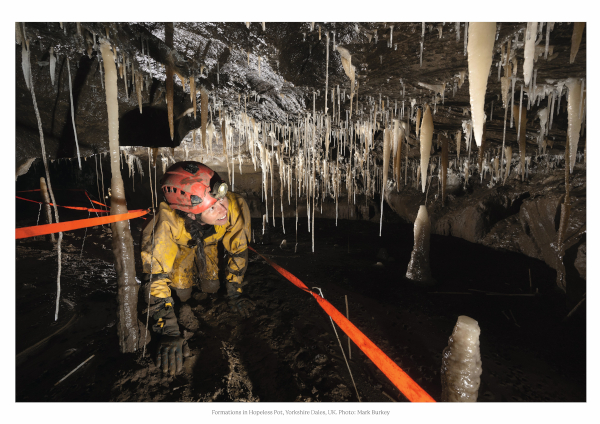
Formations in Hopeless Pot, Yorkshire Dales, UK. Photo: Mark Burkey
Hopeless Pot is a recent discovery on Leck Fell and has already become a classic trip for cavers, thanks mainly to its stunning calcite formations. These are extremely delicate, so conservation tape has been placed to protect them.
Mark Burkey is a UK cave photographer who has been published in numerous books, newspapers, magazines and journals. Winner of Adventure in the Outdoors and People’s Choice awards at the 2017 Kendal Mountain Festival, he has received the prestigious Premier trophy at Hidden Earth and is the proud recipient of the 2017 Giles Barker Award.
To see more of Mark’s photos:
https://www.flickr.com/photos/markburkey/
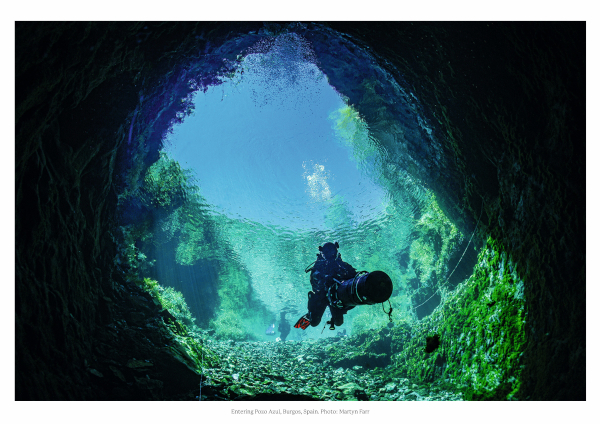
Entering Pozo Azul, Burgos, Spain. Photo: Martyn Farr
A diver leaves the clear blue waters of the entrance behind on her way to push the boundaries of this cave system in northern Spain. In 2023, the world record for longest underground dive – an underwater distance of 10,095m from the entrance – was set in Pozo Azul.
Martyn Farr is internationally renowned as a caver and cave diver. He has been an active underground explorer for over 63 years and is responsible for the discovery of miles of cave passage in many countries. He has established various national and international records in the cave diving sphere.
In recent years, Martyn has achieved spectacular results in the field of underground photography, with numerous awards to his credit. His images have been published in many books, calendars and magazines around the world. Martyn’s most acclaimed work is The Darkness Beckons, a major publication now in its fourth edition. His most recent book, Hidden Realms (2023) is a sumptuously illustrated presentation of 100 of the finest caves and mines right across the British Isles and Ireland.
To see more of Martyn’s work:
Martyn John Farr Facebook profile
or Martyn Farr Facebook page
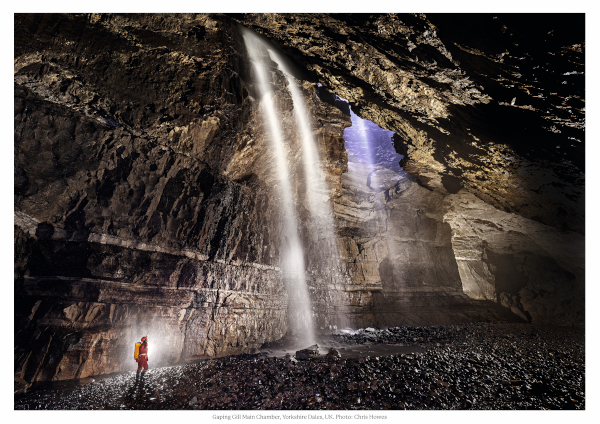
Gaping Gill Main Chamber, Yorkshire Dales, UK. Photo: Chris Howes
Under the slopes of Ingleborough lies a vast chamber, home to the highest waterfall in England. There are various routes by which cavers can access this extraordinary place, and twice a year non-cavers can be lowered down – and hauled back up – the 98m shaft on a winch.
Chris Howes is the proprietor of Wild Places Photography and Wild Places Publishing, and former editor of Descent. He has won numerous awards for underground photography, including the Giles Barker Award and the Spelean Arts and Letters Award. Chris is a Fellow of the Royal Photographic Society (FRPS) and a member of the Outdoor Writers and Photographers Guild.
To see more of Chris’ photos:
https://www.wildplacesphotography.co.uk
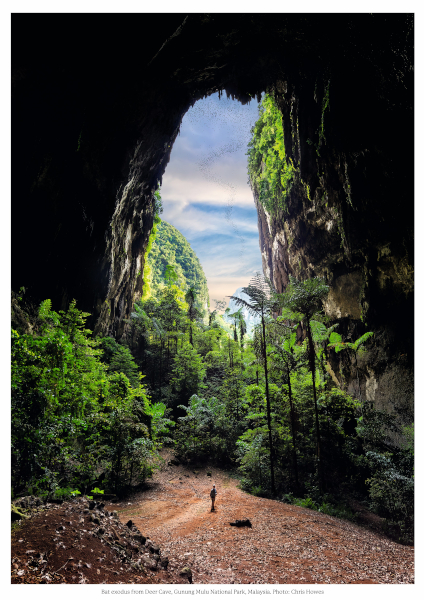
Bat exodus from Deer Cave, Gunung Mulu National Park, Malaysia. Photo: Chris Howes
The caves of Mulu are among the most spectacular in the world. Deer Cave is an immense tunnel through the mountain, with a ceiling far above and natural light permeating almost its entire length. Millions of bats roost inside and, as nightfall approaches, emerge from the entrance in an endless swirling mass.
Chris Howes is the proprietor of Wild Places Photography and Wild Places Publishing, and former editor of Descent. He has won numerous awards for underground photography, including the Giles Barker Award and the Spelean Arts and Letters Award. Chris is a Fellow of the Royal Photographic Society (FRPS) and a member of the Outdoor Writers and Photographers Guild.
To see more of Chris’ photos:
https://www.wildplacesphotography.co.uk
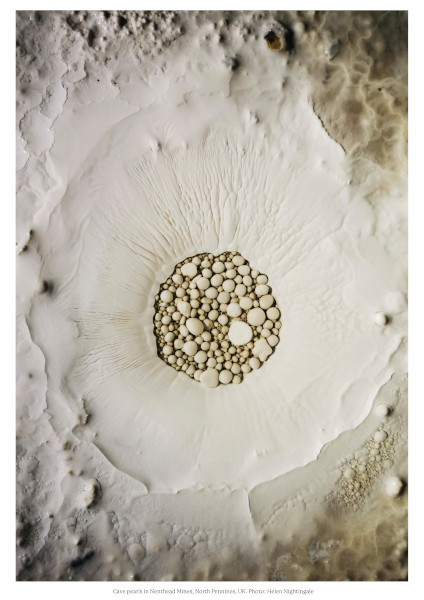
Cave pearls in Nenthead Mines, North Pennines, UK. Photo: Helen Nightingale
Water droplets landing on tiny grains of sand or grit evaporate, leaving behind a thin layer of calcite, which, layer after layer, builds up to form a cave pearl. This photo was taken in a drier area of a lead and zinc mine in Nenthead, Cumbria. Formations tend to grow faster in mines than in caves and, because of the richness of the minerals, can be found in a wide array of colours.
Helen Nightingale is a cave and mine explorer, where she enjoys getting up close to our industrial past and seeing the fossils from when the UK was under tropical seas. For her, every trip underground is a photo opportunity, and she enjoys the challenge of seeing what she can manage with the bare minimum of kit.
To see more of Helen’s photos: https://www.flickr.com/photos/on-rivers-and-rocks/
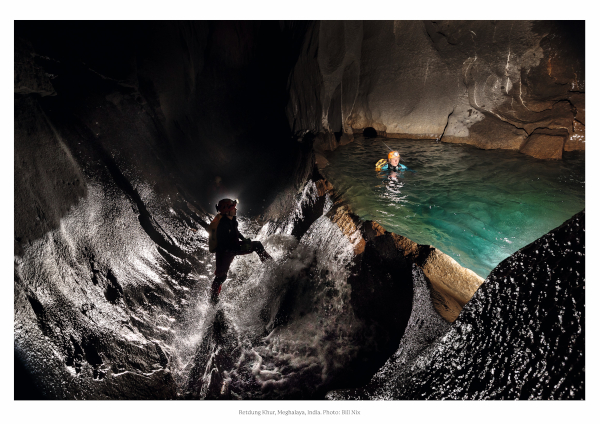
Retdung Khur, Meghalaya, India. Photo: Bill Nix
In Sanskrit, Meghalaya is known as the Abode of the Clouds. This wild part of northern India is a prolific area for cave exploration and in recent years there have been many important discoveries here, by visiting cavers and locals.
Bill Nix is a UK-based caver: He has won many awards for his underground photography, including the Giles Barker Award and the SpeleoFotoContest Sentry Award.
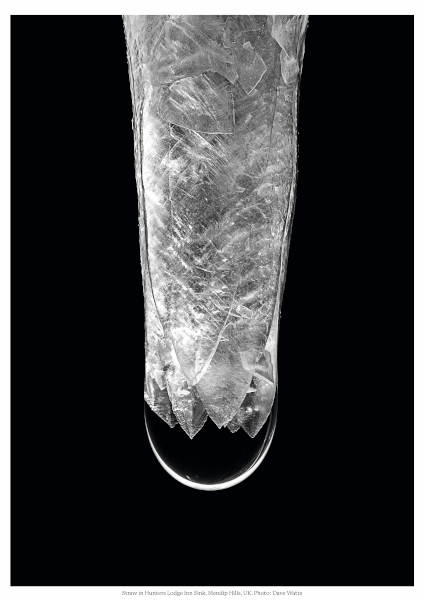
Straw in Hunters Lodge Inn Sink, Mendip Hills, UK. Photo: Dave Watts
The Mendip Hills in Somerset is one of the UK’s major caving areas. These tiny and fragile stalactites, photographed in Mendip’s Hunters Lodge Inn Sink, are formed by delicate and intricate calcite crystals, often visible only through a macro lens or magnifying glass.
Dave Watts is a landscape and events photographer based in Colchester who has combined his love of caving and cave diving exploration with his love for photography. He has recently won the Speleofotografia Competition Award in the Beauty of Caves category.
To see more of Dave’s photos:
https://www.davewattsphotography.com
https://www.instagram.com/davewattstog
Supported by Petzl: